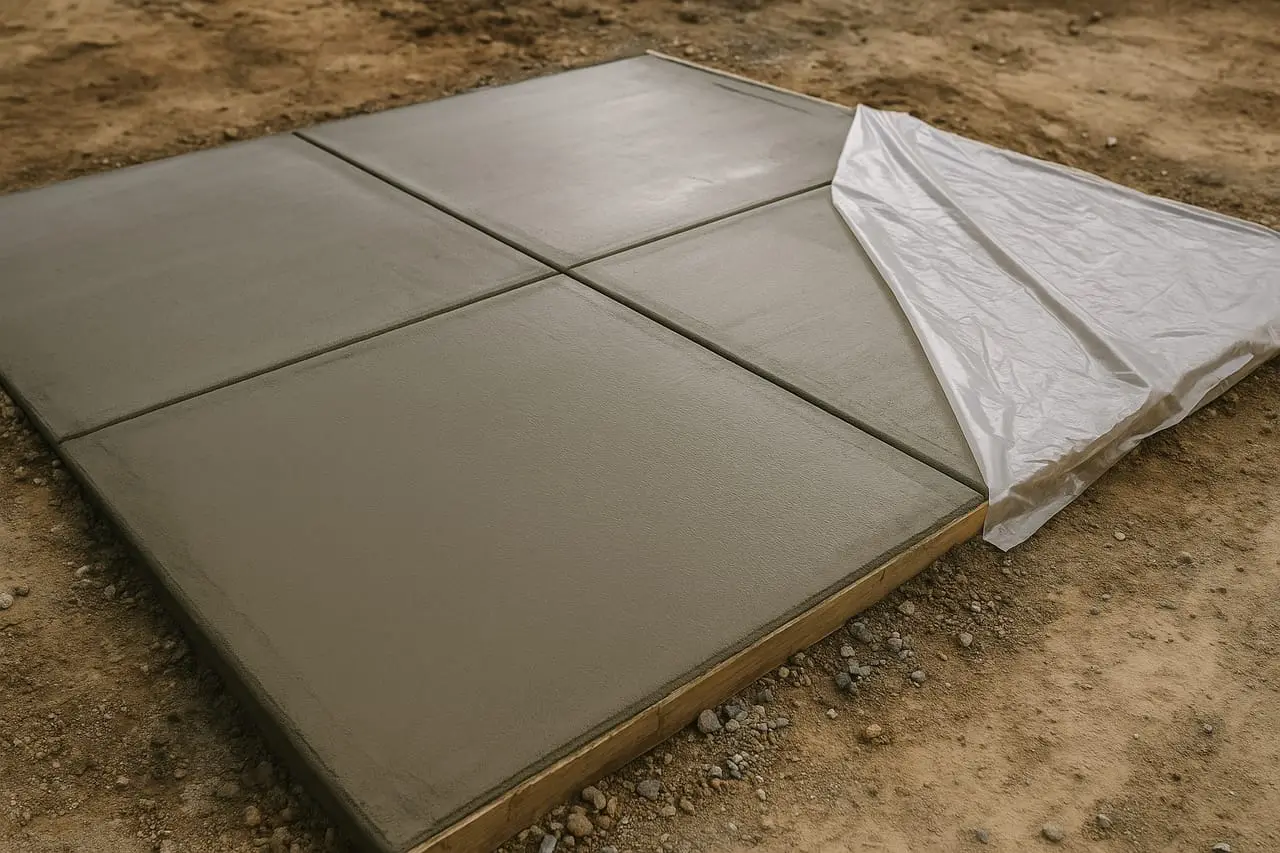
Concrete is firm enough to walk on in about 24 to 48 hours, ready to drive on at around 7 days, and fully cured at 28 days. That 28-day mark is when it hits roughly its full design strength, but you don’t have to wait that long to use it for most things. Here’s how the timeline actually works and what you can do at each stage.
Curing vs Drying (They’re Not the Same)
People mix these two up all the time, and it matters.
Drying is just water leaving the surface. Curing is the chemical reaction between the cement and water that makes concrete hard and strong. That reaction is called hydration, and it needs water to keep going.
So a slab can feel dry on top in a day but still be curing underneath for weeks. If the water evaporates too fast, the reaction stops early and you end up with weaker concrete that’s more likely to crack or dust. That’s why we wet-cure slabs or spray on a curing compound after a pour. We’re not trying to dry it out fast. We’re trying to keep it damp long enough to gain strength.
Around here in Delaware County, summer heat and dry wind are the enemy. A patio poured in direct July sun can lose surface moisture in hours if nobody’s watching it.
The Curing Timeline, Stage by Stage
Here’s the timeline most homeowner pours follow. These are typical ranges for standard residential mix in normal conditions. Cold or hot weather pushes them around, which I’ll get into below.
| Stage | Time After Pour | What You Can Do |
|---|---|---|
| Initial set | 4-8 hours | Nothing. Stay off it completely. |
| Walk-on | 24-48 hours | Light foot traffic. Stay off edges. Pull the forms. |
| Drive-on (cars) | 7 days | Park normal vehicles. ~70% of full strength. |
| Heavy loads | 28 days | RVs, trucks, dumpsters. Full design strength. |
That 7-day mark is the big one for concrete driveways. At a week, the slab is at roughly 70 percent of its strength, which is enough for a regular car or truck. But a loaded RV, a dumpster, or a contractor’s box truck can crack it. Those wait the full 28 days.
For a garage floor, same idea. You can walk on it in a day or two, but hold off rolling a loaded toolbox or parking the car until the week mark. We pour a lot of garage floors and the most common mistake we see is somebody parking on a fresh slab after three days because it “looked fine.”
What You Can Actually Do at Each Stage
Quick breakdown for the three pours we do most:
- Patios: Walk on at 24-48 hours. Hold off on heavy furniture, grills, and planters for about a week. Don’t set up a hot tub until 28 days.
- Driveways: Foot traffic at two days. Cars at 7 days. Heavy vehicles and trailers at 28 days. Keep the lawn mower and bikes off the edges early on.
- Garage floors: Walk on at a day or two. Park at a week. Wait the full month before mounting heavy shelving loads or rolling equipment.
One thing for all three: don’t seal new concrete right away. Sealer traps moisture and interferes with curing. Most sealers should go on at 28 days or later, once the slab has finished curing and dried out.
How Pennsylvania Weather Changes the Timeline
Temperature is the biggest factor in how fast concrete cures, and PA gives us the full range.
Cold slows everything down. Below about 50°F, hydration crawls. Below 40°F, it nearly stops, and if fresh concrete freezes in the first 24 hours it can be permanently weakened. A slab we’d call walk-on in 24 hours in June might need 48 to 72 hours in November. We use blankets, heated enclosures, or accelerator in the mix when temps drop. If you’re planning a late-season pour, read our take on pouring concrete in winter before you book it.
Heat speeds it up, but that’s a trap. When it’s hot and dry, the surface can set before the inside has had time to cure properly. That leads to surface cracking and a weaker slab. We pour early in the morning on hot days and keep the surface wet.
There’s also our freeze-thaw cycle to think about. Once concrete is cured, Pennsylvania winters put it through repeated freezing and thawing, made worse by road salt. Properly cured, air-entrained concrete handles it fine. Concrete that dried out too fast during curing is the stuff that starts flaking and spalling after a couple of winters.
Why the 28-Day Number Matters
Concrete keeps gaining strength for years, technically, but it slows way down after the first month. The 28-day mark is the industry standard for “full strength” because that’s when it hits the number it was designed for. Most of the gain happens in the first week, which is why 7 days is enough for normal use and 28 is the safe line for anything heavy.
If somebody tells you concrete is “fully dry” in a day, they’re talking about the surface, not the slab. The patience is worth it. Rushing a new slab is one of the few mistakes you can’t undo without tearing it out.
If you’re planning a driveway, patio, or garage floor in Upper Darby, Drexel Hill, Havertown, Lansdowne, or Springfield, we’ll walk you through the timeline for your specific project and give you a straight answer on when you can use it. Free estimates, serving all of Delaware County. Call Mike at (215) 850-7536.