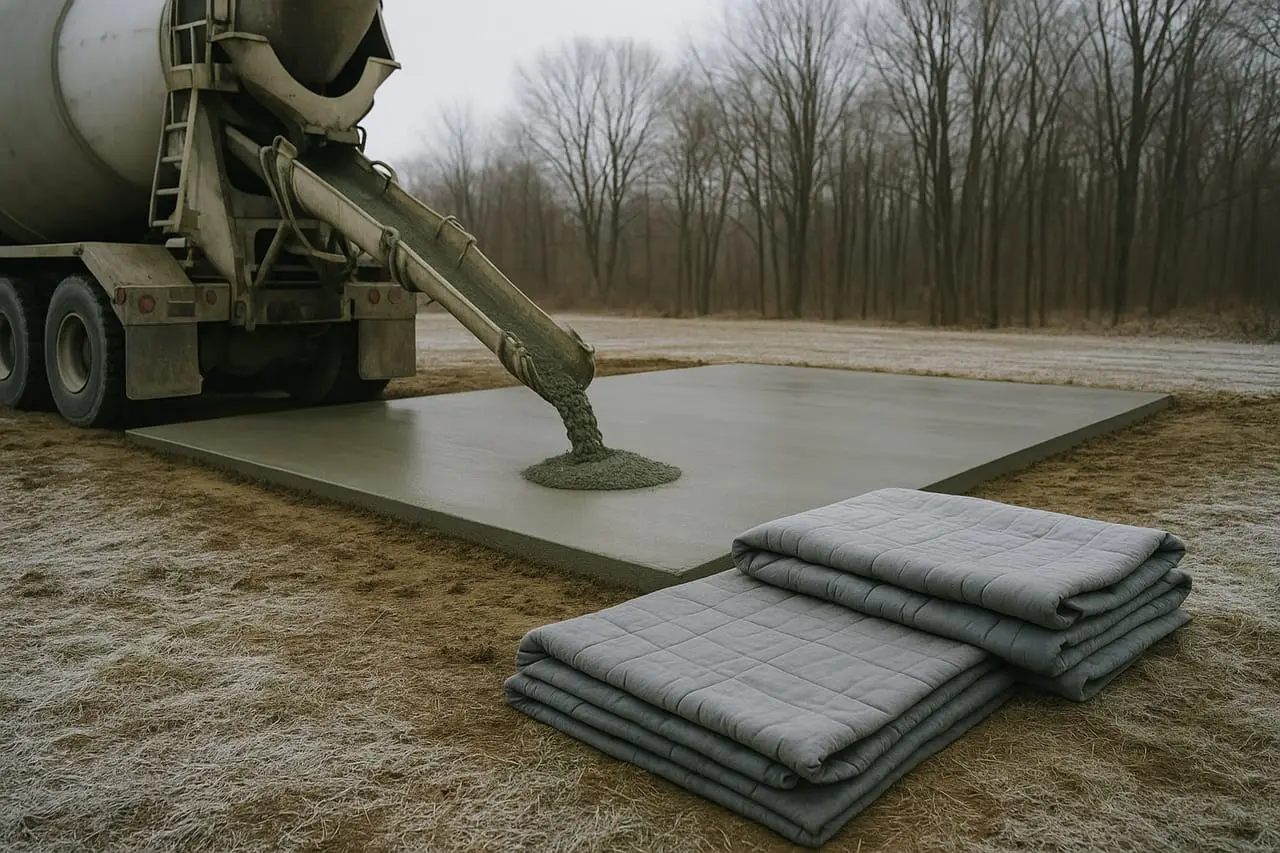
Yes, you can pour concrete in a Pennsylvania winter, but the moment the air hits about 40F and dropping, you have to take real cold-weather steps or the slab won’t gain strength right. The fresh concrete just needs to stay above freezing for the first 24 to 48 hours while it sets. Get that part right and a January pour holds up as well as a June one.
Here’s how we handle cold pours around Delaware County, and when we tell people to wait.
Why cold is the problem (it’s not the snow)
Concrete doesn’t dry. It cures through a chemical reaction between cement and water, and that reaction needs warmth to run. Drop the temperature and the reaction slows way down. Drop it below freezing before the slab has set, and the water inside turns to ice. When water freezes it expands, and that expansion shoves the still-soft concrete apart from the inside. You end up with weak, crumbly, low-strength concrete that flakes and fails a year or two later.
So the enemy isn’t a little snow on the ground. It’s the slab freezing in those first critical hours. If you keep it above freezing until it sets up, you’re fine.
The temperature line: 40F and falling
The number to watch is the air temperature and which way it’s headed.
- Above 50F: normal pour, normal procedures.
- 40F and steady or rising: still fine for most jobs, but we keep an eye on it.
- 40F and falling: cold-weather measures kick in. Heated water in the mix, an accelerator, and blankets ready.
- 25F to 32F: doable but tight. We need accelerators, insulated blankets, and sometimes a heated enclosure.
- Below 25F: usually a wait. The cost and risk of keeping it warm long enough stops making sense for most residential work.
Ground temperature matters too. We don’t pour onto frozen ground. Frozen subgrade thaws and settles after the pour, which cracks the slab. If the ground is frozen we thaw it first or reschedule.
What a proper winter pour actually involves
This is where a real contractor earns the difference between a slab that lasts 30 years and one that spalls off in three. The steps we use:
- Heated mix water. The plant heats the water so the concrete leaves the truck warm instead of cold.
- Accelerator admixture. This speeds up the set so the slab reaches a safe strength before the cold can hurt it. Non-chloride accelerators avoid corroding any rebar.
- Insulating blankets. As soon as we finish, we cover the slab with thermal blankets to trap the heat the curing reaction gives off. On a footing or wall we’ll wrap forms too.
- Protect for 24 to 48 hours. We keep it covered and monitor temps. We don’t strip forms or let anyone walk on it until it’s gained enough strength, which in cold takes longer than you’d expect. If you want the full picture on set times, see how long concrete takes to cure.
For tight backyards and basements where the truck can’t reach, we run the line ourselves. Our concrete pumping setup pushes mix through hose runs up to 150 feet, which matters in winter because you don’t want trucks idling and concrete cooling in a wheelbarrow brigade across a frozen lawn.
Winter pour vs. waiting for spring
| Winter pour (with precautions) | Wait for spring | |
|---|---|---|
| Strength when done right | Full design strength | Full design strength |
| Extra cost | Blankets, accelerator, heating add some | Standard pricing |
| Scheduling | We’re less booked, faster start | Spring is our busy season |
| Best for | Footings, repairs, deadlines, additions | Big decorative slabs, no rush |
| Risk if cut corners | High (freeze damage, spalling) | Low |
Winter does add cost: the accelerator, the blankets, and the labor to protect the pour aren’t free. On a typical residential slab around the Philadelphia suburbs that might run a few hundred dollars over the warm-weather price, but it depends on the size of the job, how cold it is, and access. We’ll always give you a straight number on a free estimate rather than guess here.
The upside: our winter calendar is lighter than spring, so you often get on the schedule faster.
When we tell you to wait
Honesty saves you money here. We’ll recommend waiting when:
- The forecast shows daytime highs staying below freezing for the whole protection window.
- It’s a large decorative or stamped job where finish quality matters and there’s no deadline.
- The ground is hard frozen and thawing it isn’t practical for the job size.
Pennsylvania freeze-thaw cycles are rough on concrete over the years, and road salt makes it worse. Starting with a slab that cured properly, in any season, is what gets you decades of life instead of early spalling. A rushed winter pour that froze is the opposite of that.
Get a straight answer for your job
If you’re wondering whether your project can go in this winter, the real answer depends on the forecast that week, the type of pour, and access to the site. We’ll look at it and tell you honestly whether to pour now or wait, no pressure either way.
Dougherty Concrete pours year-round across Upper Darby, Drexel Hill, Havertown, Lansdowne, and Springfield. We’re licensed (PA202044), 5.0 on Angi, and free estimates are exactly that. Call Mike at (215) 850-7536, or see all of our concrete services.