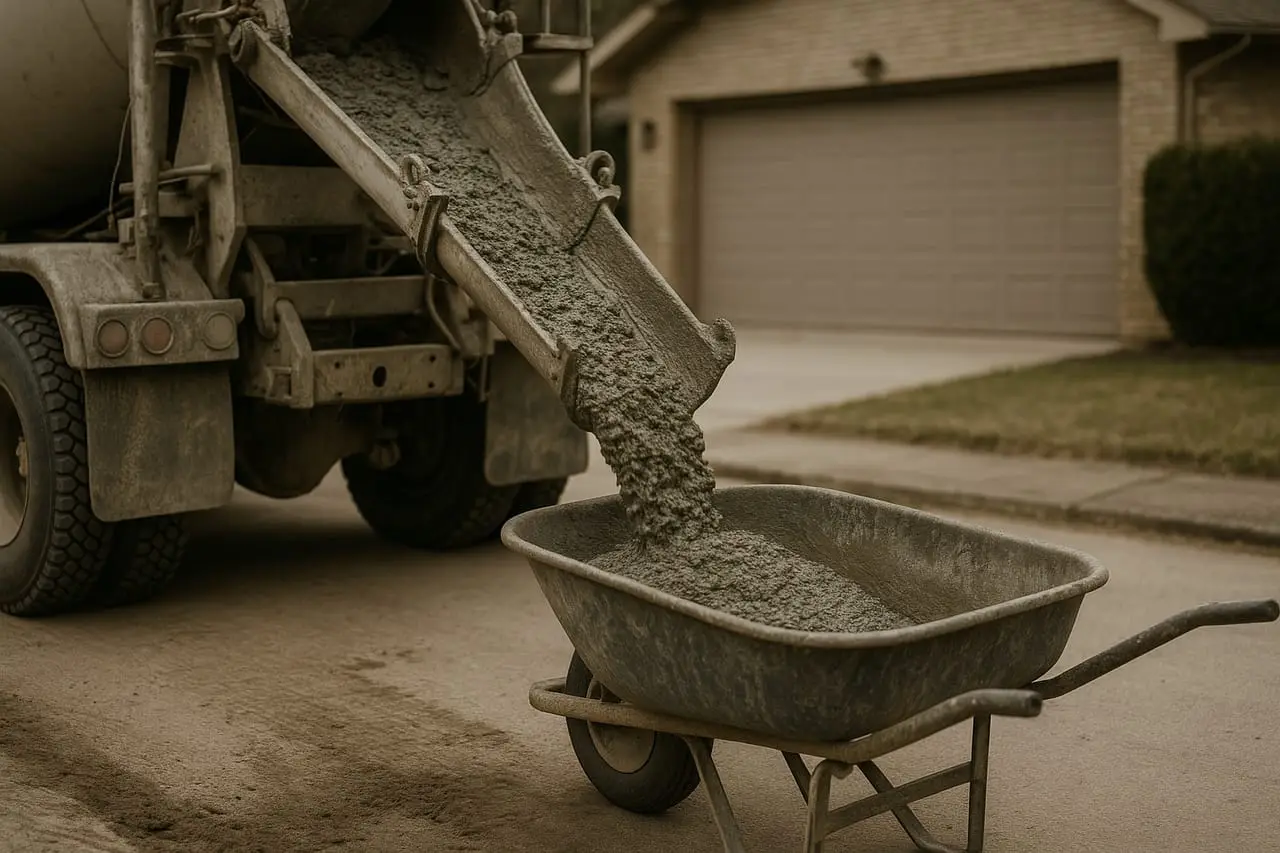
A cubic yard of concrete runs roughly $125 to $175 delivered in the Philadelphia area, and it covers about 80 square feet poured 4 inches thick. That price is for the concrete itself coming off a ready-mix truck. It does not include labor, forms, gravel base, rebar, or a pump if the truck cannot reach the spot. Mix strength, fuel surcharges, and how slammed the plant is that week all push the number around, so treat that range as a starting point and get a real estimate before you budget.
What a “yard” of concrete actually means
When a contractor says “a yard,” they mean a cubic yard. That is a block of concrete 3 feet wide, 3 feet long, and 3 feet tall, which works out to 27 cubic feet. It is a volume, not a weight, though one yard weighs around 4,000 pounds once it cures.
A standard ready-mix truck holds about 10 yards full, but most drivers carry 8 to 9 to stay legal on weight over Delaware County roads. So a single truck can usually handle a typical driveway or patio in one trip.
You order concrete by the yard. You don’t buy “a slab” or “a patio” from the plant. You figure out how many cubic yards your project needs, then add a little cushion for spillage and uneven subgrade.
How many square feet a yard covers
Coverage drops as the slab gets thicker, because thicker pours pack more concrete into every square foot. Here is what one cubic yard covers at common thicknesses:
| Slab thickness | Coverage per yard | Typical use |
|---|---|---|
| 4 inches | ~80 sq ft | Patios, walkways, standard slabs |
| 5 inches | ~65 sq ft | Heavier patios, light driveways |
| 6 inches | ~54 sq ft | Driveways, garage floors, footings |
Around here, 4 inches is standard for patios and walks, and 5 to 6 inches is what holds up for a driveway that takes a truck or two and survives Pennsylvania freeze-thaw cycles. Going from 4 to 6 inches adds about 50% more concrete, so thickness matters as much as square footage when you price a job.
How to estimate yards for your slab
The math is simple once you have your measurements:
- Measure length and width in feet to get square footage.
- Take your thickness in inches and divide by 12 to get feet (4 inches = 0.333 ft).
- Multiply length x width x thickness, then divide by 27.
Say you want a 12 x 12 patio at 4 inches: 144 sq ft x 0.333 = 48 cubic feet, divided by 27 = about 1.8 yards. Order 2 yards to leave a cushion.
A few honest notes. Subgrade is never perfectly flat, so you almost always pour a little more than the math says. Footings and odd shapes throw the numbers off. And for anything load-bearing, like the work on our foundations and footings jobs, the engineer or building department sets the thickness, not a rough estimate off a tape measure.
Delivery minimums and short-load fees
Buying one or two yards costs more per yard than buying ten. Plants set a minimum, usually around 1 yard, and they tack on a short-load fee for orders under roughly 4 to 5 yards. That fee tends to run $50 to $150 per yard short of the minimum.
There can be other line items too:
- Fuel surcharge per load, often $25 to $75
- Saturday or after-hours delivery fees
- A wait-time charge if the truck sits past its free unloading window, usually 5 to 7 minutes per yard
None of this is the plant gouging you. A truck still burns the same diesel and ties up the same driver whether it carries 2 yards or 9. If you have a small backyard pour, it is often cheaper per yard to combine it with other work or wait until you have enough volume to clear the minimum.
Where concrete pumping fits in
Plenty of jobs around Upper Darby and Drexel Hill are easy to reach. The truck backs up, the chute swings out, and the concrete slides right into the forms. No pump needed.
The trouble starts when the truck can’t get within chute range. Tight backyards, basement floors, footings behind the house, second-story decks. A chute only reaches about 16 feet, and you can’t always get the truck close. That is when you bring in a pump to move concrete through a line or boom, sometimes 150 feet of hose, to reach the spot.
Pumping is a separate cost from the concrete itself. It usually adds a few hundred dollars and up depending on access, volume, and setup. The payoff is a clean, fast pour without wheelbarrowing yards of mud across a yard, which wrecks your timeline and your back. We break down the full picture on our concrete pumping cost page so you know what drives the number before you book.
Get a real number for your project
Square footage, thickness, mix strength, access, and short-load fees all move the total, so the only honest price is one tied to your actual job. We give free estimates across Delaware County, including Upper Darby, Drexel Hill, Havertown, Lansdowne, and Springfield. Call Mike at (215) 850-7536 and we’ll walk your site, figure the yardage, and tell you straight what it’ll cost.