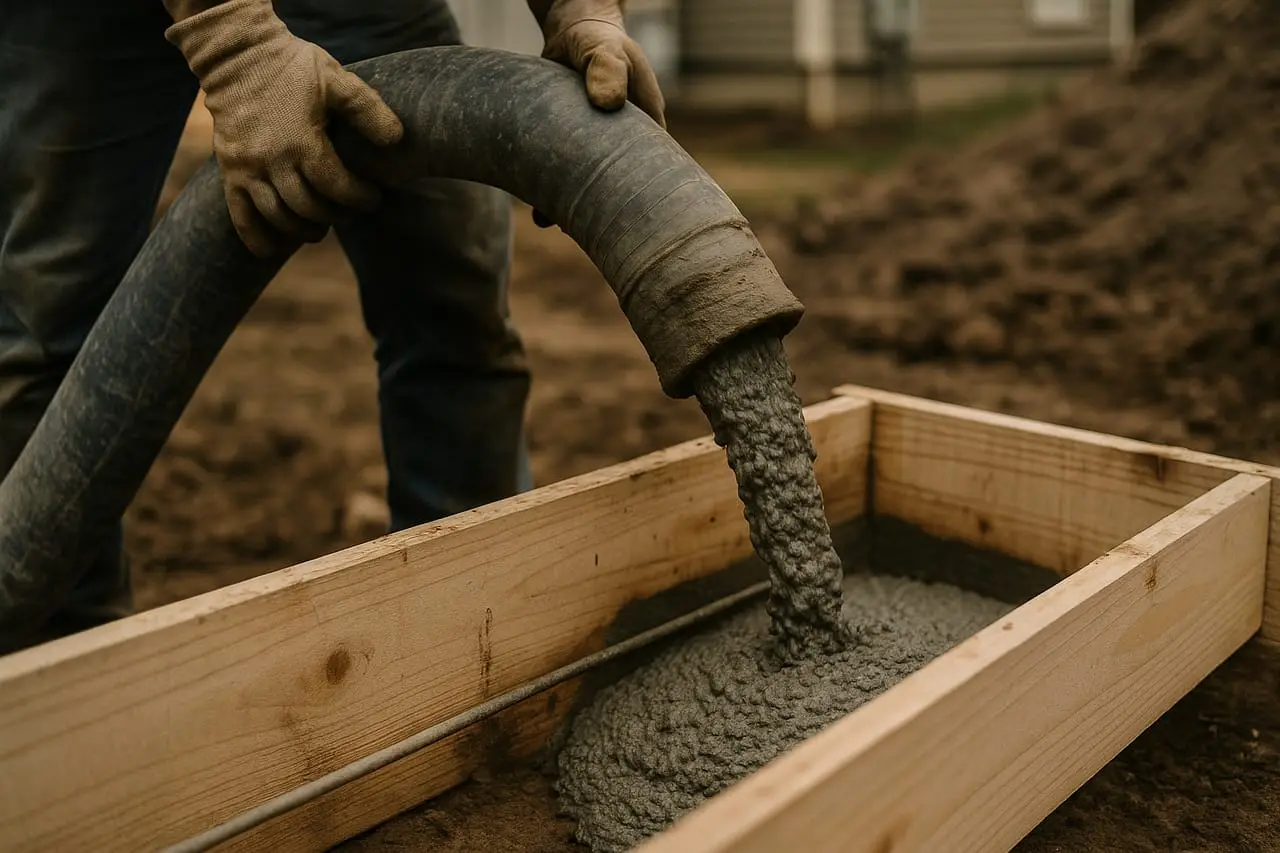
A concrete pump works by using a hydraulic piston (or in smaller rigs, a spinning rotor) to push wet concrete through a steel pipeline and rubber hose straight to where you’re pouring. One cylinder fills with concrete from the hopper while the other pushes its load out the line, then they swap, over and over, giving you a steady flow. That’s it at the core. The reason it matters for a homeowner is reach: a pump gets concrete into a backyard, basement, or footing that a truck can’t back up to.
The two pistons doing the work
Inside a piston pump there are two cylinders sitting side by side behind a hopper full of fresh concrete.
- One piston pulls back and sucks concrete from the hopper into its cylinder.
- At the same time, the other piston drives forward and pushes its load into the outlet pipe.
- A valve (usually an S-shaped tube that swings back and forth) connects whichever cylinder is pushing to the discharge line.
When the pushing piston runs out, the cylinders switch jobs and the S-valve swings to the other side. This cycle repeats several times a second, so what feels like a smooth, continuous flow of concrete out the hose is really a fast back-and-forth. Hydraulic oil under high pressure is what drives those pistons, which is why these pumps can push a heavy, gritty material a long way without bogging down.
Smaller trailer-mounted units sometimes use a rotor (peristaltic) design instead, squeezing concrete through a flexible tube with rollers. Same idea, gentler on the mix, lower volume.
Line pumps vs. boom pumps
The pump that shows up to your job depends on how far and how high the concrete has to travel. Here’s the honest version.
| Line pump | Boom pump | |
|---|---|---|
| How it delivers | Ground-level hose laid out by hand | Folding steel arm with hose on the end |
| Best for | Backyards, basements, footings, tight access | Tall pours, over rooflines, big slabs |
| Typical reach | 100–150 ft of hose | 90–200+ ft, up and over |
| Setup | Crew rolls out hose, can snake around the house | Truck parks, operator runs boom remotely |
| Footprint | Small, fits down narrow alleys | Needs room for outriggers |
Most residential work around Upper Darby and Drexel Hill gets done with a line pump because the lots are tight and the pours are at or near ground level. When you’ve got a second-story deck or a slab on the far side of a tall fence, a boom pump earns its keep by going up and over instead of around. We talk through both on every estimate.
Why the mix and slump matter
A pump can only move concrete that’s the right consistency. “Slump” is the measure of how wet and loose the mix is, and for pumping you usually want a 4 to 6 inch slump.
Too stiff and the line plugs up. A clog means the crew has to break the pipe apart, clear it by hand, and re-prime, which burns time and money on your dime. Too wet and you’ve thinned out the concrete, which means a weaker slab that’s more likely to crack once Pennsylvania’s freeze-thaw cycles and road salt start working on it every winter.
We coordinate the mix with the ready-mix plant before the truck rolls. The plant needs to know it’s getting pumped and how far, so they can dial in the slump and the aggregate size. Get that right up front and the pour runs clean.
Priming, pumping, and washout
Every pour follows the same three beats:
- Prime the line. Before any concrete goes in, the crew pushes a slurry (cement and water, or a priming product) through the empty pipe so the dry hose doesn’t grab the first load and seize up.
- Pump the pour. Concrete flows from the truck into the hopper, the pistons do their thing, and the crew places it where it needs to go. One person on the hose, others screeding and finishing.
- Wash out. When the truck’s empty, we run a sponge ball through the line to push out the last of the concrete, then flush with water before it sets. Washout gets contained and hauled off, not dumped on your property.
That washout step is non-negotiable. Concrete left in a pump line sets up hard, and clearing a cured pipe is a brutal job nobody wants.
Why it beats wheelbarrows for tight access
You can move concrete by wheelbarrow. People did it for a hundred years. But on a tight Delco lot it’s slow, it’s hard on the crew, and slow is the enemy of a good pour.
Concrete starts setting the moment it leaves the truck. The longer it takes to place, the more you’re fighting cold joints, uneven finishing, and a mix that’s stiffening up before it’s where it belongs. A pump lays down in an hour what a wheelbarrow crew needs half a day to do, and it goes places a wheelbarrow can’t, like through a basement window or 130 feet back to a detached garage.
For most homeowners the math is simple: fewer hours of labor, a cleaner pour, and concrete that’s placed while it’s still fresh. See our full breakdown of concrete pumping for how we approach access problems.
Pricing depends on the rig, the distance, and how long we’re on site, so the honest answer is it ranges and we’d rather give you a real number than a guess. Most residential pumping jobs land in a few-hundred-dollar to four-figure window depending on scope.
Get a free estimate
If you’ve got a backyard slab, a basement floor, or footings a truck can’t reach, a pump is almost always the right call. We’ll walk the site, figure out whether a line or boom pump fits, and give you a straight estimate at no charge. Dougherty Concrete serves Upper Darby, Drexel Hill, Havertown, Lansdowne, Springfield, and the rest of Delaware County. Call Mike at (215) 850-7536 for a free estimate.