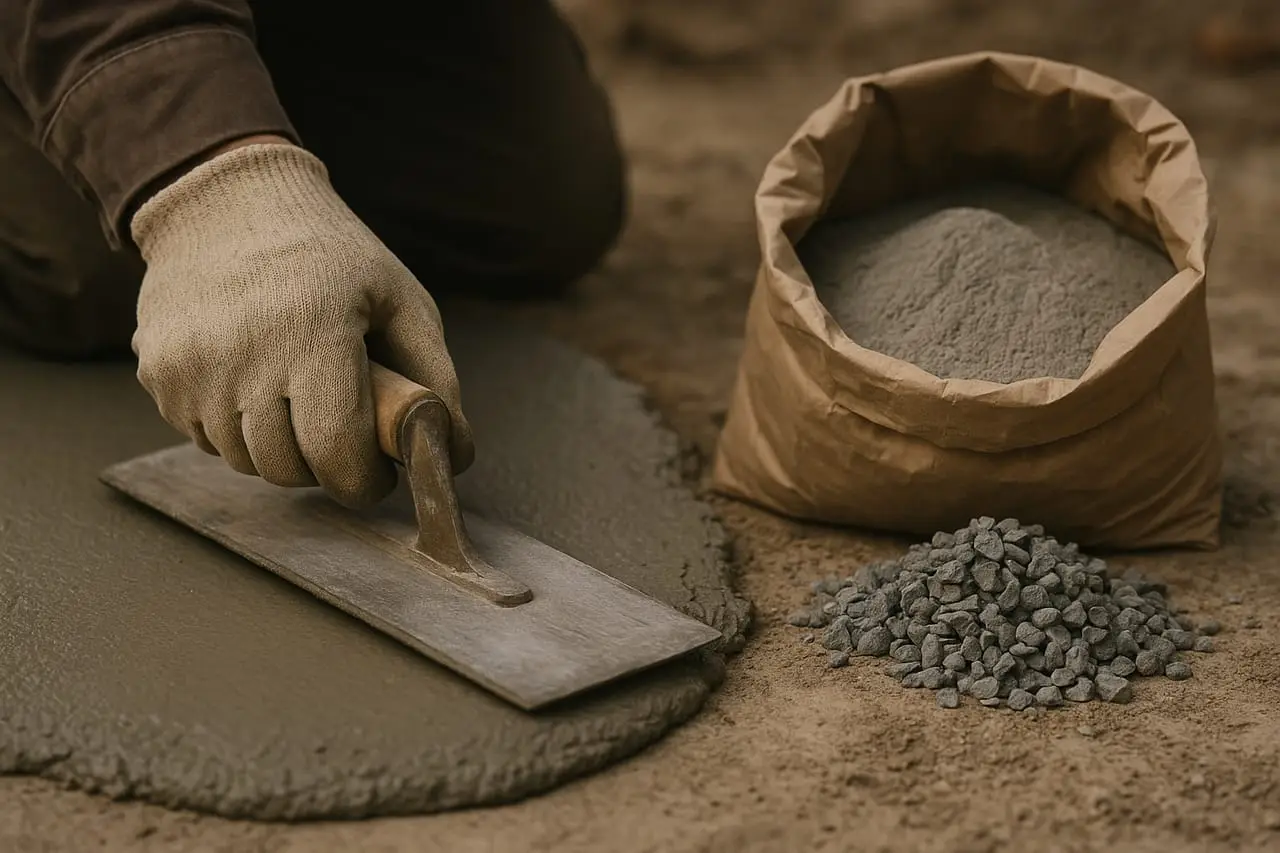
Cement is one ingredient. Concrete is the finished material you actually pour, and it’s made of cement plus water, sand, and stone (aggregate). Cement is usually 10 to 15 percent of the mix by volume. So when someone says “cement driveway,” they mean a concrete driveway. The cement is just the glue inside it.
People mix these words up every day, and most of the time it doesn’t matter. But it can matter when you’re hiring someone to pour a slab that has to last 30 years through Pennsylvania winters. Here’s the plain version.
What Cement Actually Is
Cement is a fine gray powder. The common type is Portland cement, made by heating limestone and clay in a kiln, then grinding the result. On its own, cement does nothing useful for a driveway or foundation.
Add water and it starts a chemical reaction called hydration. The paste hardens and binds whatever it’s touching. That’s the whole job of cement: it’s the binder.
You’ll see cement on its own in a few places:
- Thinset and mortar for tile and brick
- Grout
- Patching compounds
But you don’t pour a slab out of straight cement. It would be weak, it would crack, and it would cost a fortune because cement is the priciest part of the mix.
What Concrete Actually Is
Concrete is cement, water, sand, and stone mixed together. The sand and stone are called aggregate, and they make up most of the volume. The cement paste coats the aggregate and locks it into a solid mass as it cures.
A rough mix by volume looks like this:
- Cement: 10 to 15 percent
- Water: 15 to 20 percent
- Sand and stone (aggregate): 60 to 75 percent
The aggregate is what gives concrete its strength and keeps the cost down. Concrete is what we pour for driveways, patios, footings, garage floors, sidewalks, and foundations. When you hear a strength number like 4,000 PSI, that’s a concrete spec, not a cement spec.
Cement vs. Concrete at a Glance
| Cement | Concrete | |
|---|---|---|
| What it is | A binder (powder) | The finished, hardened material |
| Made of | Limestone and clay, kilned and ground | Cement + water + sand + stone |
| Used for | Mortar, grout, thinset, patches | Driveways, footings, patios, slabs, foundations |
| Do we pour it? | No, it’s an ingredient | Yes, this is what we pour |
That last row is the one homeowners care about. Nobody pours cement. We pour concrete, and cement is one of the things inside it.
Why the Difference Matters When You Hire
For everyday talk, “cement patio” is fine and we know what you mean. Where it starts to matter is the mix design, and that’s where a real contractor earns the money.
A good pour is specced for the job. A footing in Delaware County clay isn’t the same mix as a backyard patio. The variables we set on every job:
- PSI (strength). Most residential flatwork runs 3,500 to 4,000 PSI. Footings and structural pours often go higher.
- Air entrainment. This is a big one in PA. Air-entrained concrete has tiny bubbles built into it that give water somewhere to go when it freezes. Without it, freeze-thaw and road salt will spall and flake the surface within a few winters.
- Slump (how wet the mix is). Too wet and you lose strength and get more cracking. Too dry and it won’t flow or finish right.
If a contractor talks loosely about “cement” for a structural pour, ask how they spec the concrete. The answer tells you fast whether they know the trade or are guessing.
Where This Comes Up on Our Jobs
We pour concrete, and a lot of our work is getting that concrete where it needs to go. On tight Upper Darby and Drexel Hill lots, the truck often can’t reach the back of the house, the basement, or a footing dug in a side yard.
That’s where concrete pumping comes in. We run line and boom pumps with hose runs up to 150 feet to place the mix in spots a wheelbarrow can’t reach without tearing up your lawn or your back. The concrete is the same; the delivery is what changes.
Across all of it, the mix has to be right for a PA climate that freeze-thaws dozens of times a winter and gets hit with road salt every year. You can see the full range of what we pour on our concrete services page.
Get a Free Estimate
Whatever you call it, if you need something poured in Delaware County, we’ll spec the right concrete for the job and tell you straight what it costs. We serve Upper Darby, Drexel Hill, Havertown, Lansdowne, and Springfield. Estimates are free. Call Mike at (215) 850-7536.